SEC Data and Public Filings
Last updated: 10 August 2026
Everything on the Smart Investor Tracker’s seven pages, the Filing Feed, Portfolios, Promoter Buying, Special Situations, IPO Watch, Filings Search, and Reports, is read from data published by the United States Securities and Exchange Commission. This page records what the SEC itself says about reusing that data, quotes its own words, links to where they appear, and sets out what we do to stay inside those rules. The screenshots below were captured from the SEC’s website on 10 August 2026 and are kept so that our reading of its policy can be checked against the originals.
The SEC’s permission, in its own words
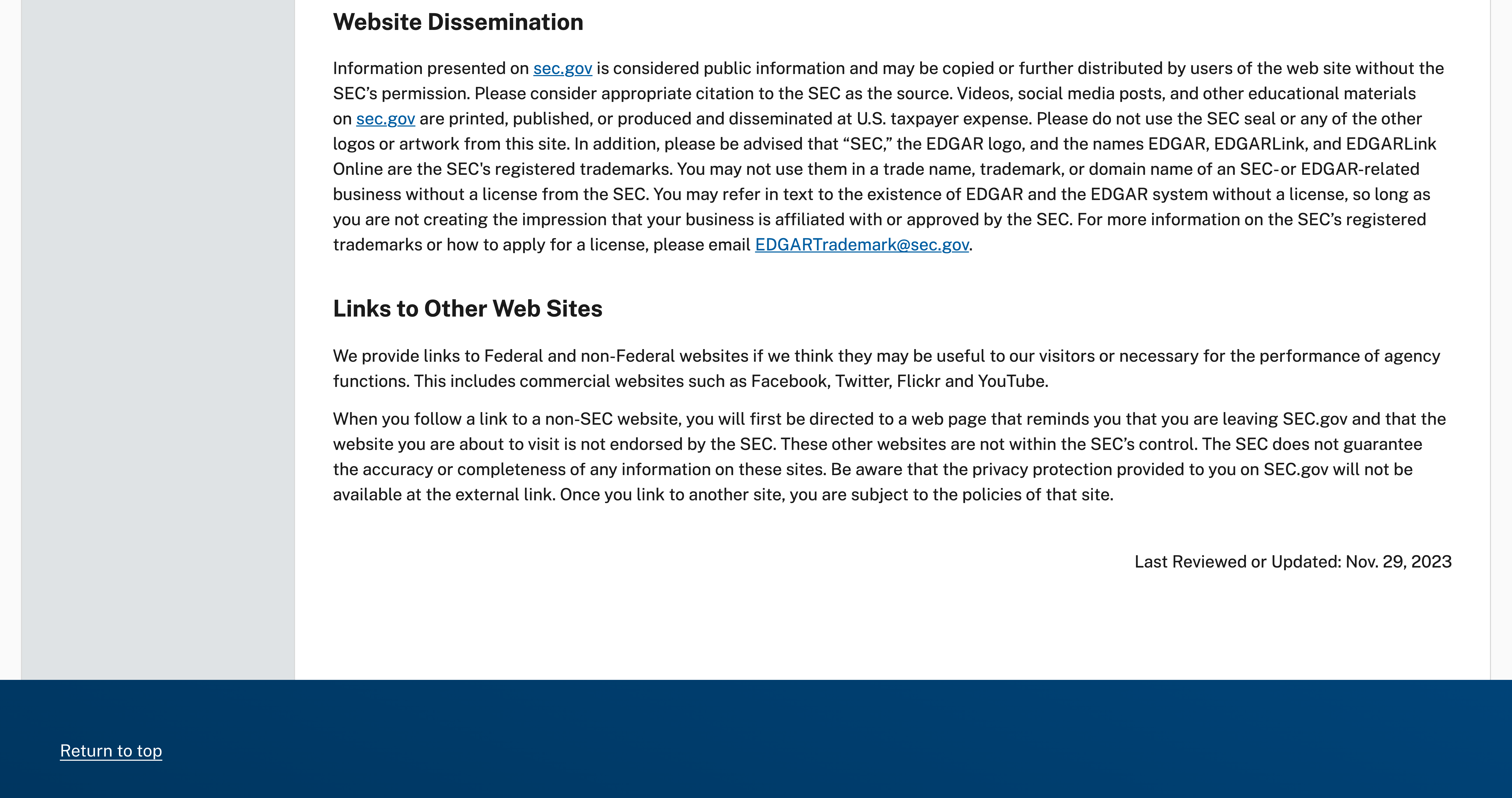
The SEC’s website privacy and security policy contains a section titled Website Dissemination, which reads:
Information presented on sec.gov is considered public information and may be copied or further distributed by users of the web site without the SEC’s permission. Please consider appropriate citation to the SEC as the source.
That is the whole of the permission, and it covers what we do: the filings we read are information presented on sec.gov, and copying and further distributing them is what a tracker is. Nothing in the policy restricts this to non-commercial use.
Source: SEC Web Site Privacy and Security Policy (section: Website Dissemination; the page notes it was last reviewed or updated on November 29, 2023).
The conditions the SEC attaches, and what we do about each
The same policy section attaches conditions. There are three that apply to us.
Citation. The SEC asks for appropriate citation to itself as the source. Every entry on our pages names the filing it came from and links to the original document on sec.gov, and the pages carry a source line naming the SEC. Anyone can follow those links and check our reading against the originals rather than take our word for it.
No seal or artwork. The SEC asks that its seal, logos, and other artwork not be used. We use none. The pages carry our own branding only.
Trademarks and affiliation. In the SEC’s words, “SEC,” the EDGAR logo, and the names EDGAR, EDGARLink, and EDGARLink Online are the SEC’s registered trademarks, and they may not be used in a trade name, trademark, or domain name of an SEC- or EDGAR-related business without a license. Our names and domains contain none of them. The policy goes on to say that anyone may refer in text to the existence of EDGAR and the EDGAR system without a license, so long as you are not creating the impression that your business is affiliated with or approved by the SEC. We refer to EDGAR only in text, as the system the filings come from, and the pages state plainly that the SEC does not endorse, sponsor, or verify them and is not affiliated with us in any way.
How we collect the data: the SEC’s access rules
The SEC publishes separate rules for automated access to its data. Its Accessing EDGAR Data page states, under Fair access:
Current max request rate: 10 requests/second.
Please declare your user agent in request headers.
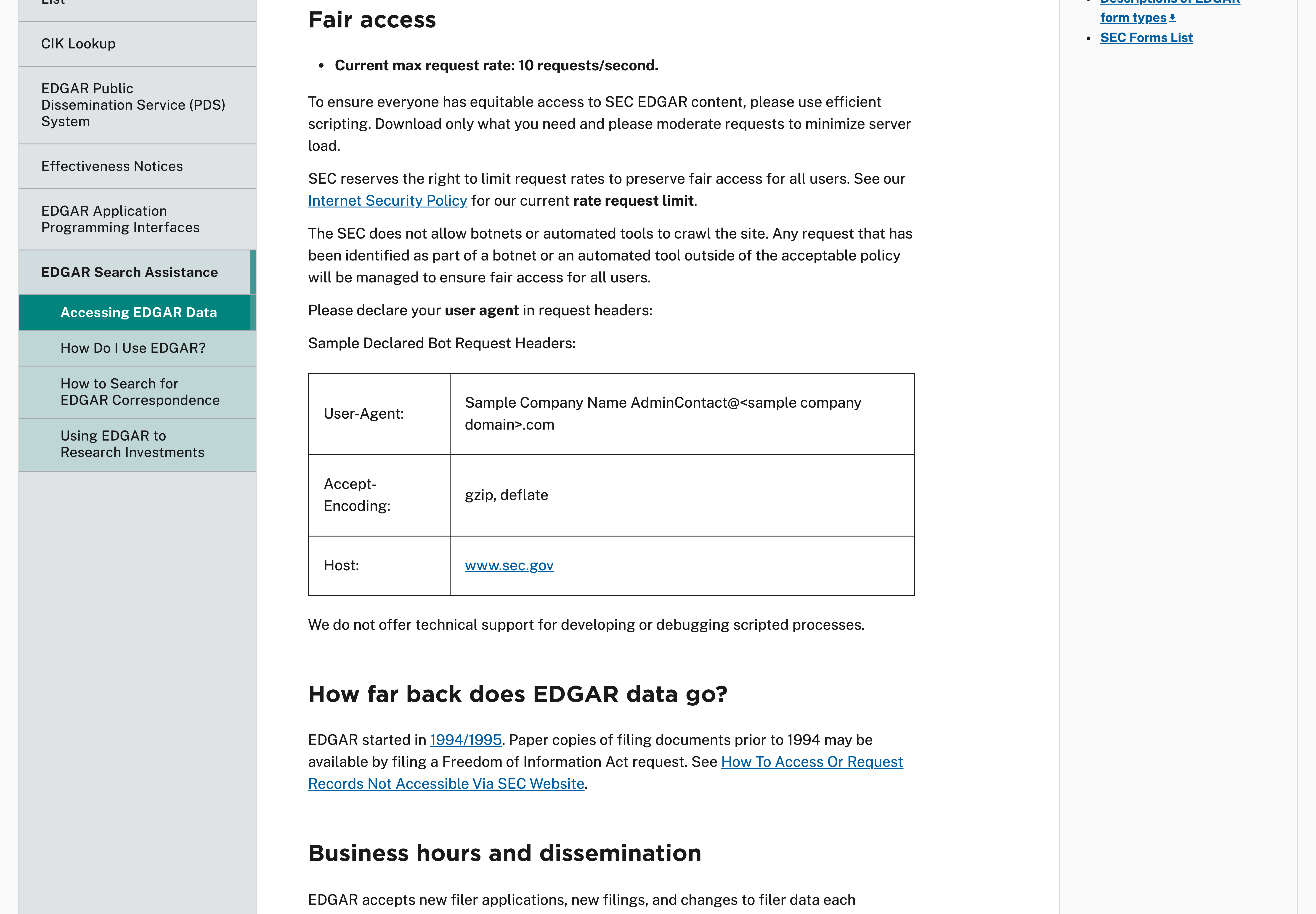
Our collection follows both. Every request our system makes carries a declared identity naming this publication and a contact address, exactly as the SEC’s sample headers prescribe. The system runs on a fixed schedule: five fixed jobs every morning between 07:45 and 08:45 IST, after the SEC’s filing day closes (EDGAR accepts filings until 10:00 pm US Eastern), making a few dozen requests in total, a small fraction of the permitted rate, and nothing like the botnets the rule is aimed at. Our pages state this refresh schedule in their footers, and they are never updated live within the day.
Nor is the data something we are merely tolerated in taking. The SEC maintains a dedicated programming interface for exactly this purpose, in its own words:
“data.sec.gov” was created to host RESTful data APIs delivering JSON-formatted data to external customers and to web pages on SEC.gov. These APIs do not require any authentication or API keys to access.
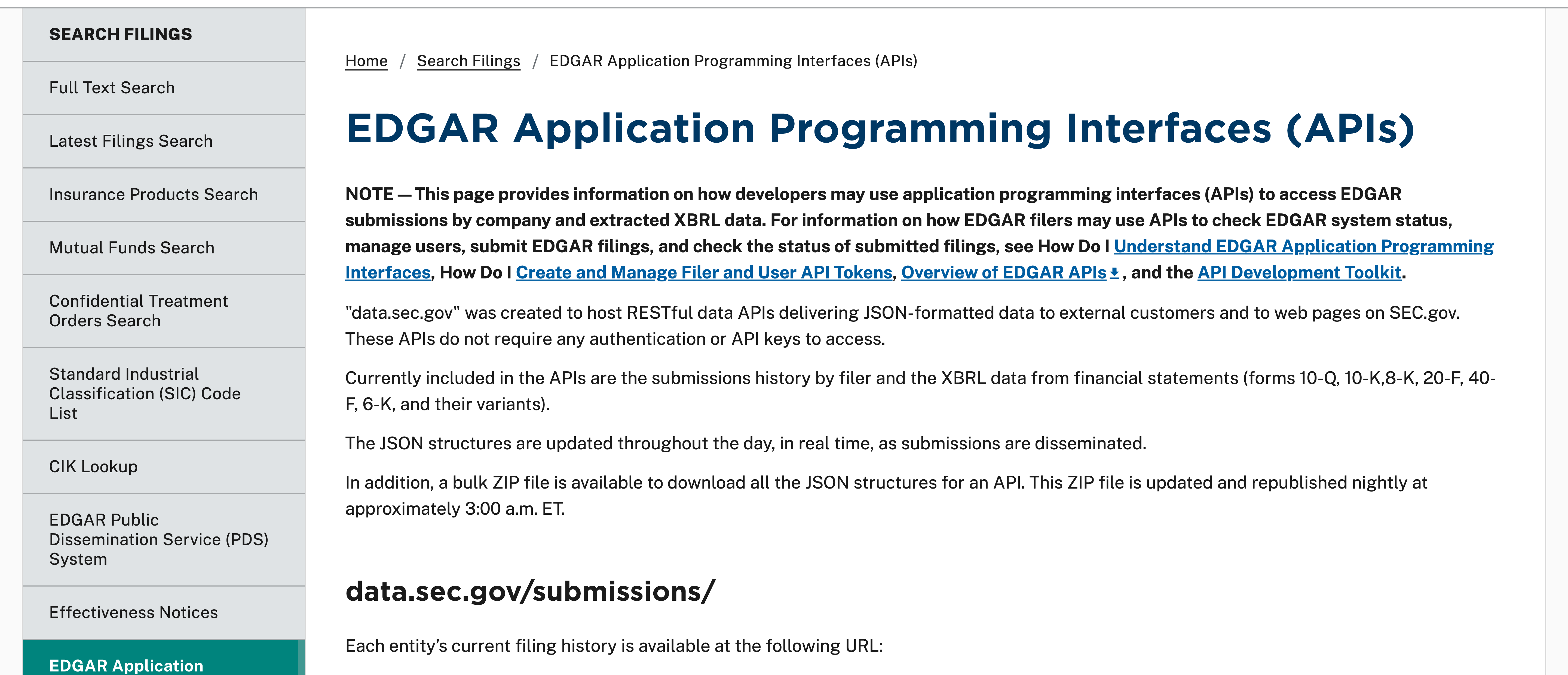
That interface is what we read: each tracked filer’s public filing history, straight from the SEC’s own servers.
What can still go wrong
Two cautions follow from the SEC’s own descriptions, and both are why our pages carry an errors-and-omissions line.
Filings can change after we read them. The SEC notes that filings are sometimes corrected or removed at the filer’s request after acceptance, and that such changes are folded into its indexes only on a schedule. A snapshot like ours can therefore drift from the live record until the next collection run. The original on sec.gov is always the authoritative version, which is why every entry links to it.
The SEC does not vouch for what filers write. The filings are the filers’ own statements, published by the SEC, not verified by it. A holding or a trade can be misreported by the filer and later amended. We read what is filed; we cannot read what was meant.
And the usual, because it applies here too
This publication is impersonal commentary of general and regular circulation. It is not investment advice, it is not a recommendation to buy or sell any security, and it is not tailored to any person or their circumstances. Please read the full Disclaimer before relying on anything here.
Questions are welcome at hello@themicrocapminute.in.